Reflexology | What Is It and How It Works (Best Foot Massage in Sinking Spring)
Looking for “reflexology near me? You’re in the right place…
Relax your body and mind with a luxurious massage at Lords and Ladies Salon & Medical Spa in Sinking Spring, PA. Whether you are looking for relaxation, an energy boost or healing, we offer exactly the right type of massage therapy to meet your needs!
The Lords and Ladies Salon & Medical Spa property in Sinking Spring has a unique history. The federal-style stone mansion at 4912 Penn Avenue, known locally as the Krick House, was built in 1815 and was expanded, renovated and transformed into a Lords and Ladies Salon in 2015.
Today, we have grown to seven salons in Berks and Montgomery Counties, in Douglassville, Exeter, Fleetwood, Gilbertsville, Perkiomenville, Pottstown, and Sinking Spring, PA.
We offer a complete range of services to customers, including haircuts, hair color, balayage, nails, waxing, facials, peels, dermal fillers, Botox cosmetic services, massage therapy and more. Our stylists attend advanced training programs throughout the year to keep abreast of new techniques and further hone their skills.
Reflexology is so much more than just a massage — it’s a roadmap to relaxation.
By using gentle touch to stimulate specific points or meridians on the feet, hands, or ears, your massage therapist can unlock points of tension throughout the entire body. But that’s not all: Science demonstrates that reflexology may offer benefits including better sleep, less anxiety, and more.
Have we got your attention? Keep reading to discover the wonderful world of reflexology, including what it is, how it’s done, and reflexology benefits for both mind and body. By the time you’re done reading, you’ll want to book an appointment at Lords & Ladies in Sinking Spring ASAP!
What is Reflexology?
Before we go any further, let’s get clear on what reflexology is — and what it isn’t.
Reflexology, or reflexology massage, is a method of applying gentle, targeted pressure to specific points on the body — most notably the feet, but reflexology can also be performed on the hands and ears. These reflexology points purportedly connect with specific parts of the body. By stimulating these points, you may experience relief in other parts of the body.
How do reflexologists know what points to press? There are “reflexology maps” that help practitioners identify hot spots so they can address any issues you’d like to work on. Here’s an example of a foot reflexology map:
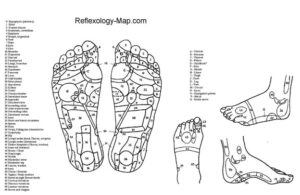
(Source: Wikimedia Commons)
As you can see, different areas of the foot correspond to different parts of the body — for instance, the inner arch is related to your digestive organs, and the big toe contains the reflexes that correspond to your head, and so on. Confused? Let’s talk about how it works in practice.
Reflexology: How it Works
Say that you’ve booked a foot reflexology session because you’ve been experiencing digestive issues. Your reflexologist will stimulate reflexology points on the inner arch of your foot that are correlated to the digestive organs, which may provide relief. (That’s just one example of the many reflex points on your feet.)
Wait … They touch your feet to treat your belly? How does that work? There are a few theories about how and why reflexology points work.
Some say that reflexology points are hubs where nerve bundles converge. So, if this is the case, by stimulating a nerve ending on your foot that is connected to the nerves in your digestive system, reflexology may indirectly stimulate the trouble area and bring relief.
In China, where reflexology is said to have originated, the belief is that stimulating these reflexology points unlocks blockages in your chi, or vital life energy. By tending to these blockages, energy can flow more freely throughout the body, bringing relief and healing energy to both specific areas and the entire body.
Also worth noting: While reflexology is commonly known as a type of deep tissue foot massage, it’s not just for feet. Hand and ear reflexology may not be as common, but they’re just as enjoyable.
How is Reflexology Different From Traditional Massage?
If you’ve had a professional massage before, the methodology for reflexology may feel a little different. Here are a few key differences:
- Reflexology is not done on the entire body — it’s typically performed on specific areas including the feet, hands, and ears.
- With reflexology, the massage therapist may not be working directly on the area that you want to target. For instance, if you have shoulder tension, they won’t work on your shoulder — they would work on the corresponding reflex point, which is located below the pinky toe. There’s a reflex for just about every body part. Do a Google Image search for “reflexology map” to explore.
- Reflexology may or may not be done with oil.
- Reflexology tends to focus on specific reflex points rather than the long, flowing, kneading strokes that characterize a full-body massage.
- Reflexology focuses on specific trigger points; massage tends to address entire muscle groups.
Reflexology Benefits
Time for the good stuff: Reflexology benefits. Here are just a few of the purported benefits of reflexology:
Pain Relief
While reflexology typically employs gentle pressure, it can have a powerful effect on aches and pains.
A 2018 study of over 300 patients monitored the effects of reflexology on patients being treated for chronic pain. The results? Following 25 minutes of reflexology, 94% of the patients reported a significant reduction in pain.
Suffering from low back pain? Targeted research demonstrates that reflexology may provide relief from chronic low back pain.
That’s not all. Additional analysis reviewing several studies on reflexology’s impact on MS patients found that it both reduced pain and fatigue.
Improved Mental Health
Not only does reflexology feel good for your body, but it can do wonders for your emotional wellbeing.
Case in point: Consider the results of randomized controlled trials monitoring the effects of reflexology on depression, anxiety, and sleep quality. Meta-analyses found that foot reflexology “significantly improved” adult depression.
But that’s not all…
Better Sleep
One of the other findings of the randomized controlled trials mentioned above? Reflexology had a significant impact on sleep quality that was directly related to the frequency and duration of reflexology.
Additional research analyzing 42 studies among over 4,000 individuals with sleep issues found that reflexology had a profound effect on sleep quality and reduced sleep disturbances.
What lesson are you taking from all of this? How about, it’s time to book some reflexology?
Digestive Relief
Are you among the 40 million+ Americans who struggle with digestive issues? If so, reflexology could provide some relief.
While research is limited, it is promising. For example, a small study among women struggling with chronic constipation found that 94% of participants experienced relief following a six-week course of reflexology.
Additionally, a review of seven different studies concluded that reflexology may be an effective complementary therapy for digestive issues.
Reflexology Massage: The Final Word
Reflexology is a little different than other types of massage, but its many benefits, stress-reducing qualities, and the fact that it feels really, really good make it worth a try.
For best results, be sure to book your reflexology session at a reputable business that specifically offers reflexology (not just massage) services. As for the question “Where can I find reflexology near me?”, the answer is clear: Book your session at Lords & Ladies in Sinking Spring today.